
Sage
Engineering intelligence.
On demand.
Structured intelligence extracted from operational data + physics-based calculations + domain knowledge.
Made accessible through conversational AI.
- Shortlisted for the 2nd AI Startup Award at the Asia-Pacific Conference of German Business (APK)
Stop wasting weeks on manual cross-tool analysis to answer every engineering question.
You have cutting-edge simulation tools and data acquisition systems, and your engineering team has decades of domain knowledge. Yet answering a straightforward engineering question (How does a change in material properties impact performance?) still takes days of locating datasets, cleaning telemetry, running models, and writing custom scripts.
General-purpose AI tools do not have access to your validated physics models, calibrated parameters, proprietary methods and operating context. Sage gives conversational AI engineering context.
Sage gives conversational AI the structured engineering intelligence it needs to help engineering teams investigate complex problems on demand. Workbench enables engineering teams to create, validate, reuse, and deploy proprietary engineering intelligence across their workflows.
How Sage works
Sage common intelligence layer
01
Connect raw data
Integrate raw sensor streams, historical testing datasets, third-party simulation tools, and domain applications while keeping sensitive raw telemetry inside your own infrastructure.
02
Structured intelligence
Automatically transform millions of noisy telemetry points into validated, physically meaningful parameters such as internal resistance trends, thermal stress indicators, and degradation curves.
03
Engineering intelligence
Ask complex engineering questions in plain language. Sage reasons over physical features of your assets and, when it needs more detail, runs simulations or pulls raw data to find root causes and show which assets to fix first.
04
Create, validate and deploy
Use Workbench to write your own physics calculations, test new features against past operating data, and set up diagnostic alerts. Everything you build goes into a reusable library that deploys straight to cloud or edge.
Develop a reusable library of institutional engineering intelligence with Workbench
01
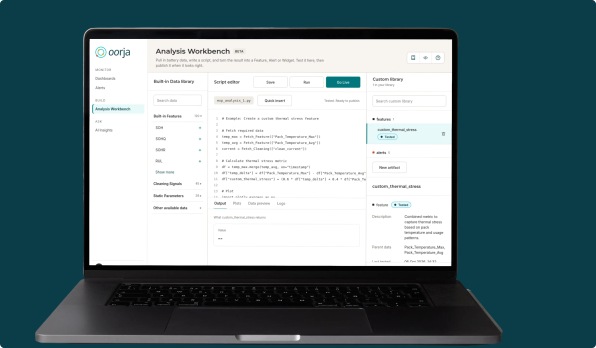
Create features and calculations
Encode your team’s proprietary knowledge by defining new analytical parameters, selecting relevant datasets, and previewing the results.
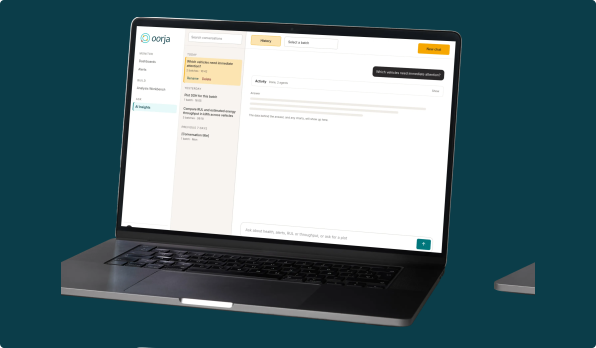
02
Validate against historical operating data
Test custom calculations and diagnostic threshold alerts against existing asset data to verify accuracy before putting them into production.
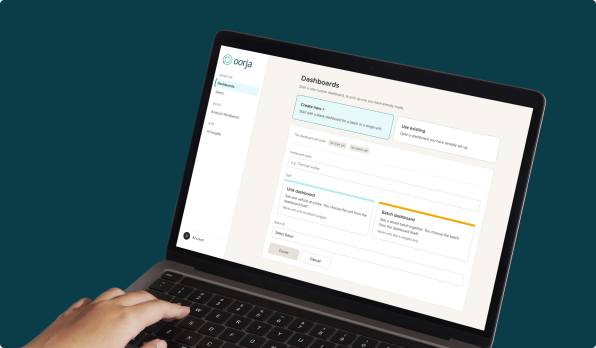
03
Reuse across teams and inquiries
Publish validated features and diagnostic methods to a shared institutional library so any engineer across the organization can query and apply them on demand.
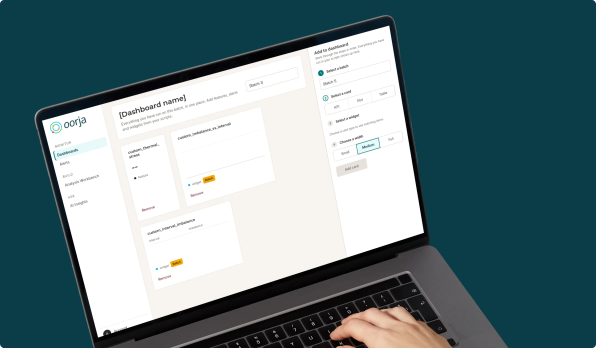
04
Deploy directly into live workflows
Connect analysis with action by deploying validated features and alerts across active systems to support ongoing monitoring, reliability management, and cloud or edge applications.
Sage advantage
Why Sage outperforms manual workflows & general-purpose AI
01
Faster investigation & implementation
Ask a question, query validated features, and get actionable diagnostic answers in minutes.
Days or weeks spent identifying datasets, cleaning data, running simulations, and writing bespoke scripts.
02
Physics-grounded reliability
Grounded in physical laws, calibrated parameters, and validated engineering algorithms that reflect real-world operating constraints.
Disconnected from proprietary models and operating context, and unable to reliably infer complex physical behaviour from millions of raw sensor measurements.
03
Compounding engineering intelligence
Accessible to every engineer with zero data-science learning curve; once a calculation or diagnostic method is built in Workbench, it becomes a permanent, reusable asset for the entire organisation.
Siloed scripts and one-off software development projects that have to be rebuilt from scratch for every new investigation.
Trusted by engineering leaders
“Sage provides a dependable, scalable pathway to deploy enterprise AI without compromising accuracy, reliability, or intellectual property.”
Vineet Dravid Ph.D
Founder & CEO, oorja“Sage equips engineering teams to investigate problems faster, reuse validated models, and deploy diagnostic alerts into live workflows, without expecting every engineer to become a data scientist, simulation specialist, or AI expert.”
Prashant Kumar Srivastava Ph.D
CTO, oorja
Key features
Improve engineering productivity, accelerate deployment, and increase ROI of AI deployment
Lower AI compute & bandwidth overhead
- Reduces unnecessary data movement.
- Lowers the cost and complexity of operating AI at scale.
- Supports deployment in environments where bandwidth, latency, or compute resources are constrained.
Private & on-premise data control
- Retains sensitive raw engineering data within your own infrastructure via private or on-premises deployment options.
- Safeguards proprietary intellectual property and data confidentiality.
- Enables secure and controlled AI adoption across the organisation.
Seamless integration with existing engineering investments
- Derives greater returns from existing simulation tools, data acquisition systems, testing infrastructure, and analytics software.
- Connects capabilities from BattForge, BattPulse, and BattAssure with third-party domain applications.
- Accesses underlying raw data or simulation workflows only when detailed analysis is required.
Cloud to edge workflow deployment
- Deploys validated features and alerts to support live monitoring, diagnostics, and reliability management.
- Supports operational deployment across both cloud and edge applications.
- Operationalises engineering intelligence without disrupting established workflows.
Fewer avoidable failures,
lower testing and operating costs,
and faster engineering decisions.
01
Fleet and Asset Degradation Analysis
Why are specific vehicles or battery packs in a fleet degrading faster than others?
Converts continuous voltage, current, and temperature streams into specific diagnostic indicators: checking whether internal resistance is rising abnormally, whether a cell group is diverging, or which operating regimes are accelerating ageing, to separate design issues from real-world usage.
02
Custom Features and Alerts
How does cumulative high-temperature exposure during fast charging impact pack longevity?
Using Workbench, an engineer defines a custom calculation for cumulative thermal exposure during fast-charge events, previews and validates the feature against historical fleet data, builds a threshold alert, and deploys it across active vehicles without writing a separate software application.
03
Early Fault Detection
Which deployed assets are showing early precursors to component failure, and how much usable capacity remains?
Identifies abnormal operating signatures across thousands of field assets to calculate failure likelihood and remaining useful life, catching safety or warranty risks early and reducing redundant physical testing cycles.
04
R&D Simulation
How will a change in material properties or operating limits affect next-generation system performance?
Feeds field diagnostic findings directly back into upstream design and simulation workflows, allowing design engineers to query validated physics models and evaluate material or architecture changes before committing to physical prototypes.
FAQs
Questions about Sage? We have the answers.
Get the most out of your engineering data, your validated models, and your team.
See how Sage and Workbench turn fragmented datasets and physics models into reusable, on-demand engineering intelligence.