
BattForge
Book a demo with us
BattForge connects physics-based engineering environment for battery design, calibration, simulation, and life prediction.
oorja’s BattForge brings together electrochemical modelling, experimental data, parameter optimization, performance simulation, degradation prediction and system analysis in one connected workflow.
Start with cell chemistry & test data. Build and calibrate models. Explore performance, fast charging and degradation. Scale from cells to packs. Compare results and extract engineering insights.
Business outcomes
01
Fast-charging optimization
Large vehicle OEM · Passenger OEM · Battery Swapping OEM
40% time saving
- 40% time saving to freeze, test, and deploy protocol
- Delivers impact on thermal signature and warranty issues
- Charging time reduced from 88 minutes to 66 minutes in case study
02
Thermal Runaway Prediction
Passenger OEM · Battery Pack Maker
80% speedup
- 80% speedup in simulation time vs conventional FEM
- Pack-level TR propagation heat maps in hours, not weeks
- Enables certification test preparation at early design stage
03
Warranty Estimation
Mobility OEMs · Pack OEMs
70% TTM saving
- 50% speedup in warranty finalization
- Up to 70% time-to-market saving
- Accounts for ΔT, ΔQ, ΔIR cell variation across pack
04
Dynamic SIL/HIL Testing
Mobility OEMs
Real-life fidelity
- Testing captures real-life electrical and thermal response
- Eliminates static battery pack proxy in test loops
- Full electro-chemical response visible across pack lifecycle
One connected workflow, not separate tools.
Each app can be used on its own, but the real value comes from using them together: outputs and understanding developed in one stage feed directly into the next.
01 / Material
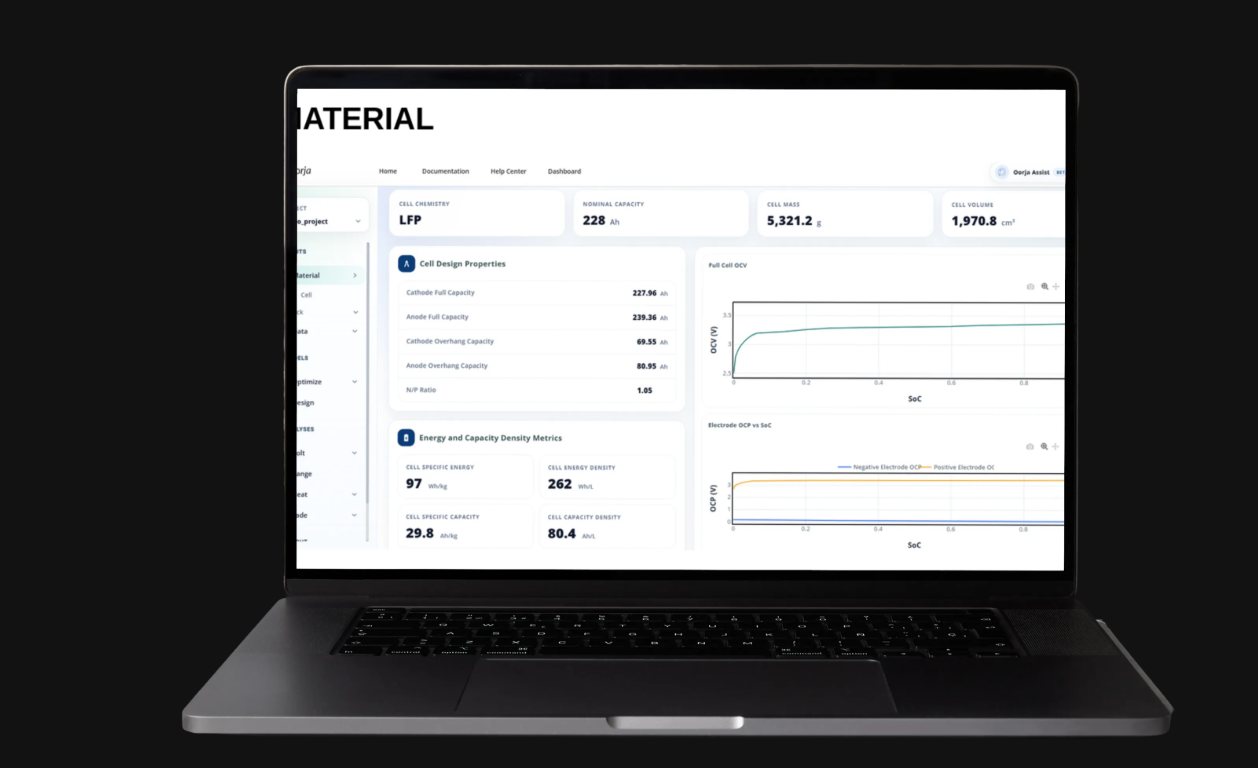
Material
Build the physical foundation of your battery model.
Define cell materials, electro-chemical properties and design parameters with the control needed to create simulation-ready physics models.
Key features
- 01
Define electrode, electrolyte, and electro-chemical material properties.
- 02
Perform cell stoichiometric balancing.
- 03
Estimate cell design and geometric parameters.
- 04
Configure parameters for physics-based SPM and DFN models.
- 05
Create reusable cell definitions for downstream simulations.
Key outcomes
- Build physically meaningful cell models.
- Reduce manual effort in cell model setup.
- Maintain control and traceability over modelling assumptions.
02 / Data
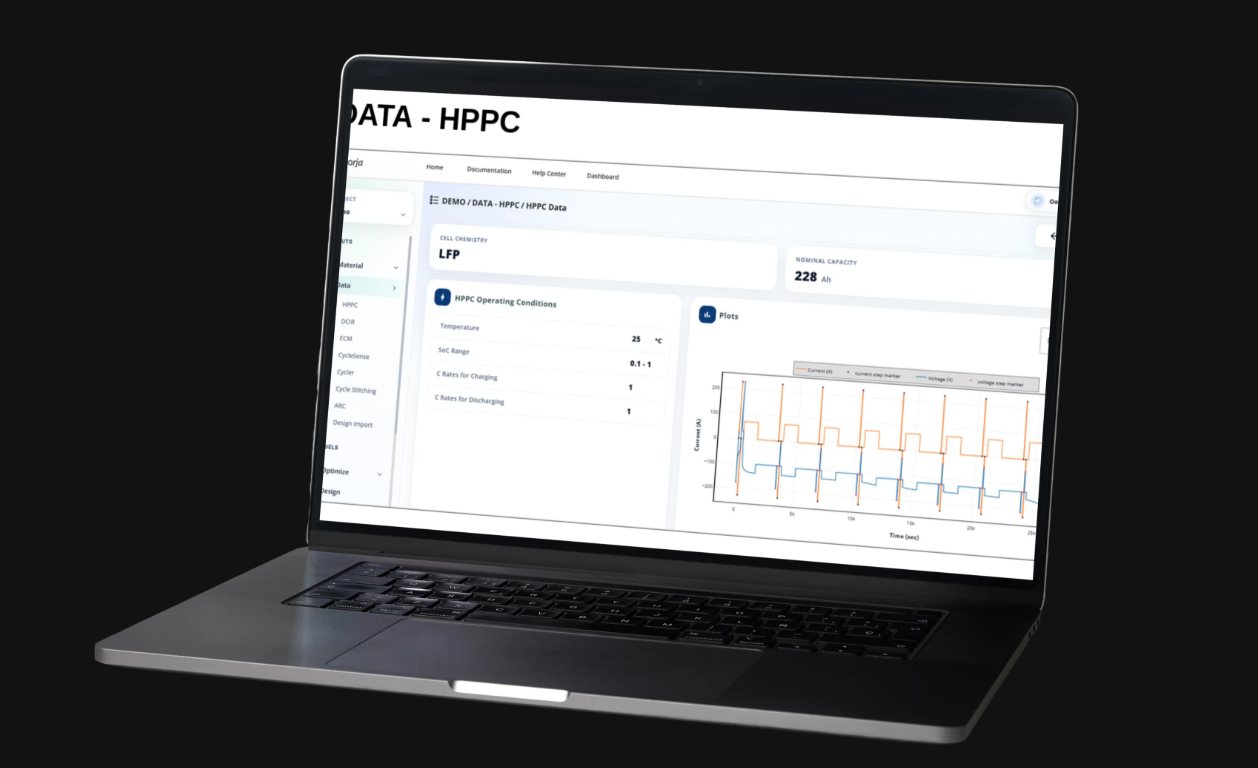
Data
Turn experimental & real-world battery data into engineering-ready information.
Import, structure, and interpret complex battery datasets while automatically extracting the information needed for modelling, diagnostics, and experiment design.
Key features
- 01
Import HPPC, DCIR, Cyclic ageing, RPT, and ARC datasets.
- 02
Automatically stitch multi-file ageing datasets and intermediate RPTs.
- 03
Extract pulses, C-rates, test conditions and cycling information.
- 04
Perform ICA and investigate dominant degradation mechanisms.
- 05
Build custom cycles & convert duty cycles into C-rate and temperature buckets using Cycle Stitching and CycleSense.
Key outcomes
- Reduce battery data preparation effort.
- Extract more engineering insight from existing test data.
- Design experiments that better represent real-world usage.
03 / Optimize
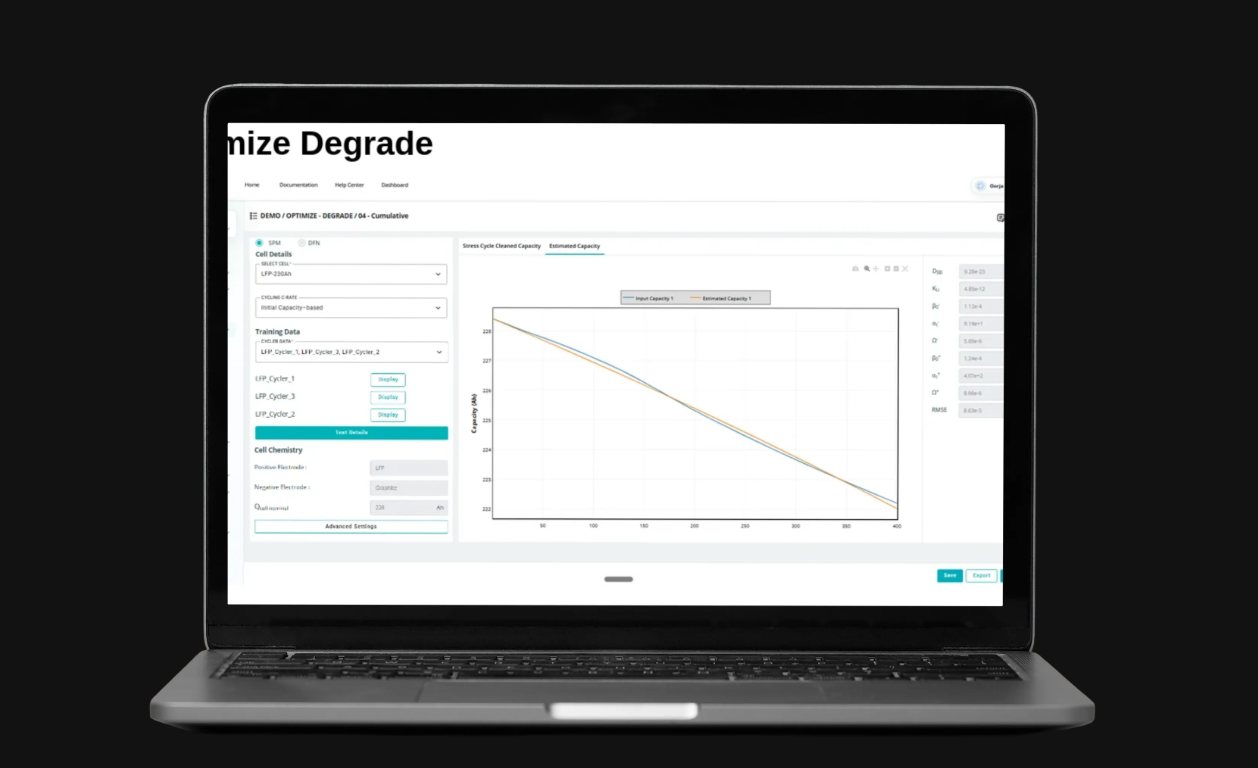
Optimize
Calibrate battery models directly from experimental data.
Use measured battery behaviour to estimate the physical and degradation parameters required for predictive simulations.
Key features
- 01
Optimize transport and electro-chemical properties using HPPC data.
- 02
Calibrate degradation using cyclic ageing datasets.
- 03
Estimate calendar ageing parameters.
- 04
Optimize thermal runaway parameters using ARC data.
- 05
Automate parameter fitting against measured battery behaviour.
Key outcomes
- Create calibrated models that reproduce real cell behaviour.
- Reduce manual parameter tuning and calibration time.
- Extend experimental knowledge to operating conditions that were not physically tested.
04 / Volt
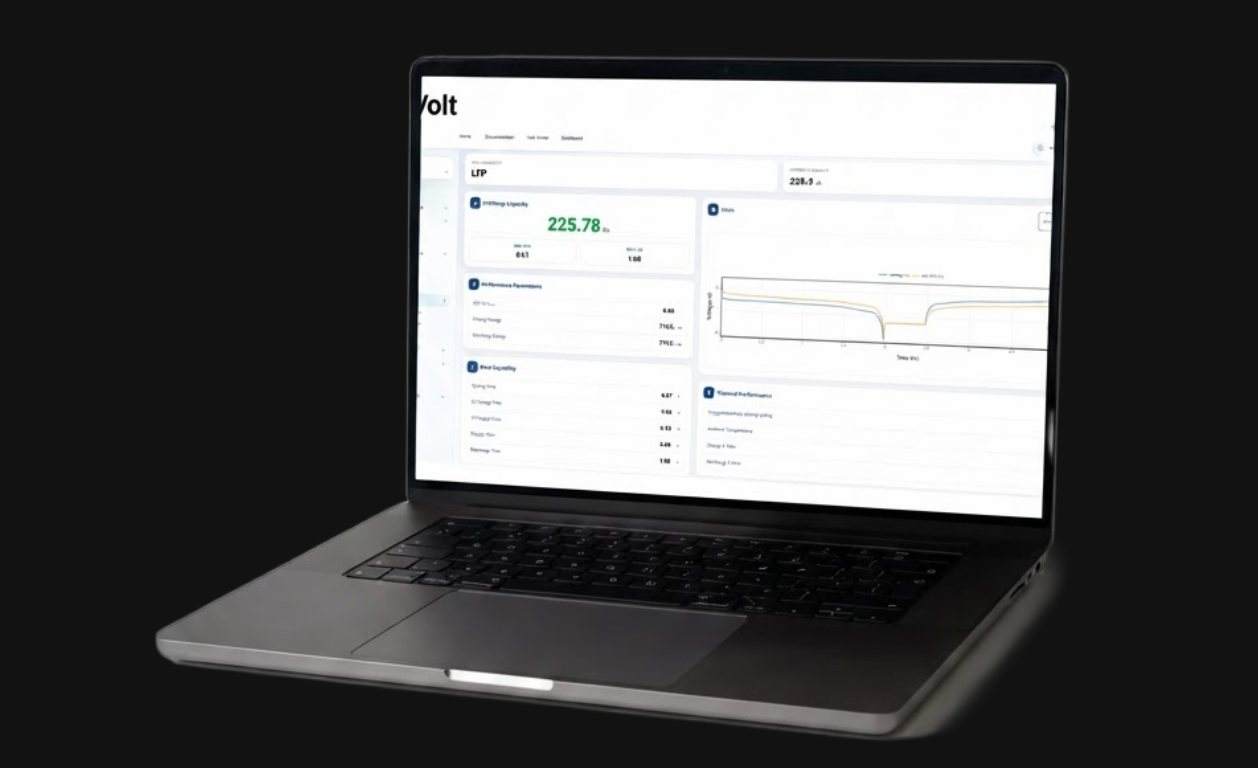
Volt
Predict battery performance across real operating conditions.
Use physics-based models to study voltage response, power capability, charging behavior, and electro-chemical limits from cell to pack.
Key features
- 01
Simulate performance using both SPM and DFN models.
- 02
Evaluate dynamic charge and discharge behaviour.
- 03
Investigate fast-charging strategies across SOC & temperature.
- 04
Identify operating conditions associated with lithium plating.
- 05
Model pack behaviour using physics-based models or efficient ECMs for apps like SIL.
Key outcomes
- Explore performance before extensive physical testing.
- Design faster and safer charging strategies.
- Generate battery models for system and controls development.
05 / Fade
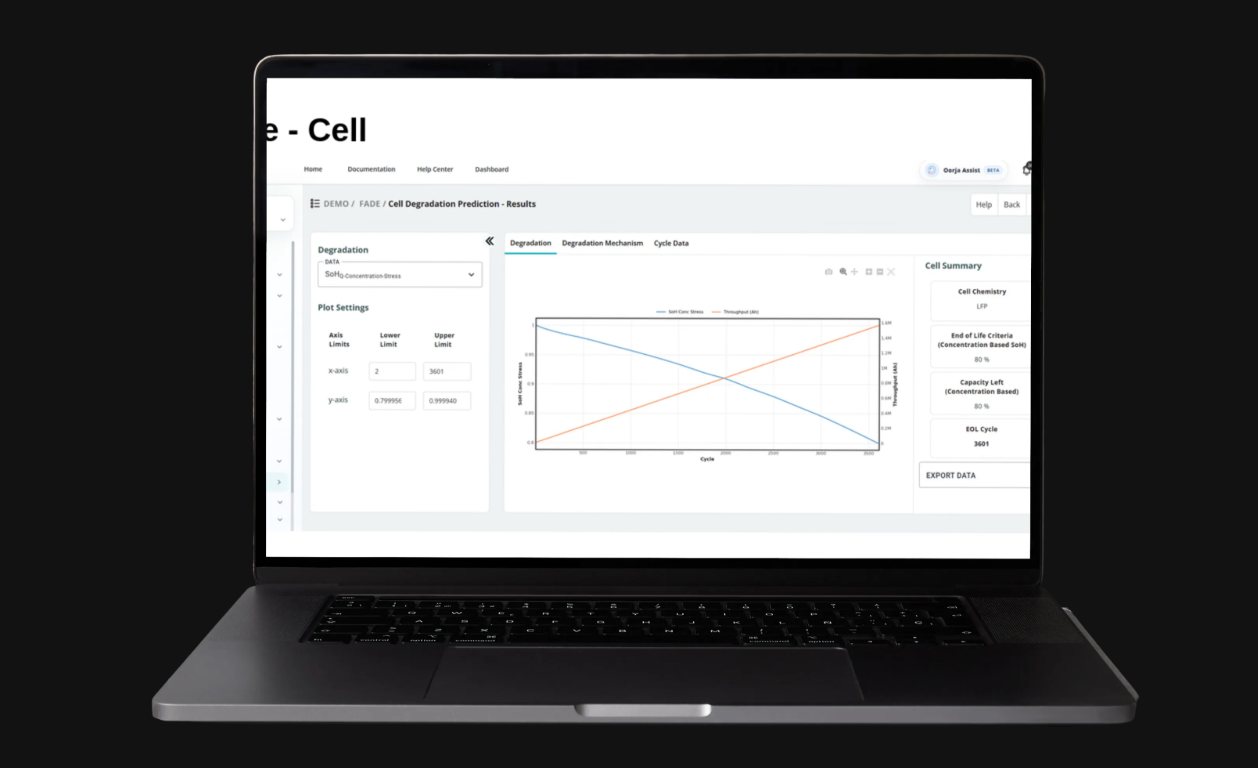
Fade
Predict battery degradation from cell to pack, with physics-based and foundational models.
Model how batteries age under real operating conditions, scale degradation to pack level, and predict life even when extensive ageing data is not available.
Key features
- 01
Model physics-based degradation mechanisms across C-rate, temperature & operating conditions.
- 02
Simulate ageing using laboratory cycles, custom profiles and real-world duty cycles.
- 03
Scale from cell-level degradation to pack-level ageing and performance prediction.
- 04
Evaluate the impact of cell variability and ageing on pack behaviour over life.
- 05
Predict ageing from BOL information & a limited representative capacity-retention curve.
Key outcomes
- Predict battery life from individual cells through complete packs.
- Reduce dependence on long-duration ageing datasets for new cells.
- Evaluate battery and pack behaviour across operating scenarios before running every physical ageing experiment.
06 / Range
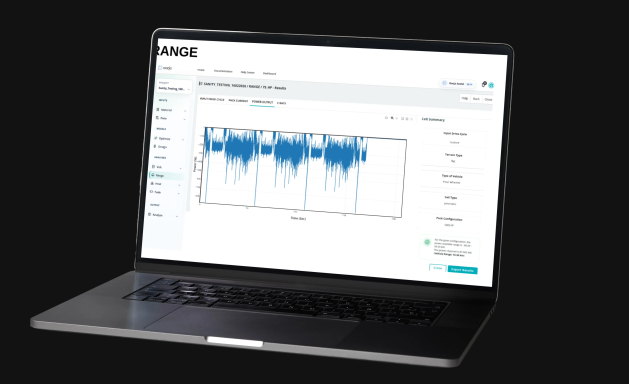
Range
Translate battery performance and ageing into real-world vehicle range.
Combine pack characteristics, vehicle duty cycles and battery degradation to understand how usable range evolves throughout vehicle life.
Key features
- 01
Define battery pack and vehicle operating conditions.
- 02
Import or create user-defined drive and duty cycles.
- 03
Estimate range for specific operating profiles.
- 04
Evaluate the impact of battery ageing on usable range.
- 05
Compare range across designs, duty cycles and stages of life.
Key outcomes
- Connect cell-level behaviour with vehicle-level performance.
- Predict how customer range changes as the battery ages.
- Evaluate battery and pack design choices against real-world usage.
07 / Analyze
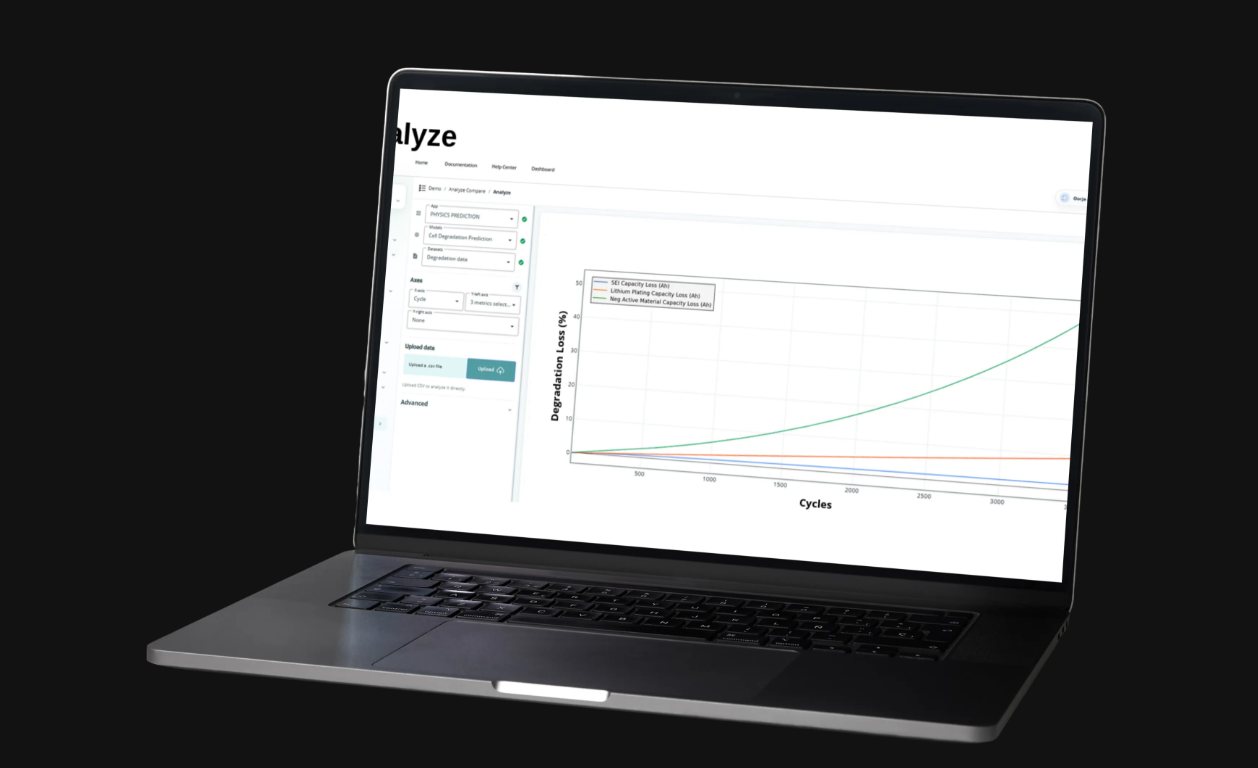
Analyze
Bring simulations, experiments and battery variants together in one engineering analysis environment.
Compare results across cells, operating conditions and ageing stages, with AI-assisted tools to help engineers investigate what changed and why.
Key features
- 01
Compare multiple cells, simulations and configurations.
- 02
Overlay experimental and simulated results.
- 03
Plot voltage and performance evolution across ageing cycles.
- 04
Analyse trends across operating conditions and simulation runs.
- 05
Use AI-assisted analysis to interrogate results and get insights.
Key outcomes
- Understand differences between cells and simulations faster.
- Identify trends and relationships across larger result sets.
- Turn simulation outputs into actionable engineering conclusions.
Book a demo
Bring your cell chemistry, test data or duty cycles. Fill three fields, then pick a time, or ask us to call you.